

Printer-Friendly

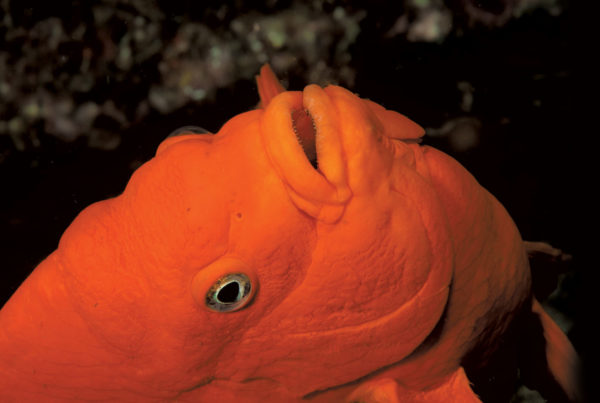
No other fish along our coast has more a predictable behavior than the bright orange garibaldi. And perhaps more important is that no fish has a behavior that can be manipulated as easily as the garibaldi. You can make them come, fetch, stay, heel and more. Just a few simple tricks will have you getting garibaldis to pose and flip for great photos and impress your friends.

ORANGE GLOVES
Bright orange gloves, about the same color and tone of the garibaldi themselves, can be found at just about any hardware or garden supply store. The are ordinary garden gloves, but for us divers they are “garibaldi gloves” and key to manipulating behavior. Find extra large orange gloves that can be worn over your regular dive gloves. Or, if the water is warm enough, you can wear them as your dive gloves. You can wear one or both. You then become like a conductor at an orchestra. Holding your hand in the shape of a fish, fingers together with hand flat, flip your hand around within 10-15 feet of a garibaldi and odds are they’ll come running. To them, this is another fish exhibiting a confrontational behavior. Being territorial and intensely curious the garibaldi will investigate the commotion. For a more confrontational look when the garibaldi comes close, point your fingers down at about 45°. For garibaldi, a head down pose is an aggressive stance. Once you have the garibaldi’s attention you can now move your hand around to position the fish as you wish.

SNAP YOUR FINGERS
When garibaldi are in a confrontational mode, they will often make a popping noise in their throat. You can imitate this by snapping your fingers. The trick works best when the fish is within 10 feet or closer and with your orange gloves but it also works with other gloves.

MIRRORS
Garibaldis react with zeal to their own image. This again plays off their intense territoriality. Sometimes they will react to their own image in your mask, but for guaranteed fun, bring down a mirror underwater. For safety and portability purchase a plastic pocket mirror (vary in size from 4” to 7”) from the camping section of a sporting goods store. These small mirrors will fit in your BCD pocket with little fear of breakage.

OLD STANDARDS
Of course there are the old standard practice of breaking open an urchin to create a feeding frenzy. Garibaldi become so focused on eating the urchin guts that you can get quite close. There a number of problems with this practice. First, it kills another animal. Second, it puts a lot of ick in the water, a special problem if you're participating in photography. It also attracts every other fish within 30 feet, a problem if you are trying to photograph just garibaldi. And finally, they will exhibit an unnatural feeding frenzy behavior. If you want to attract fish, a better plan would be to rub rocks together. The sound will bring them in.

Another old standard is to find a garibaldi nest and drop in a small object. The male garibaldi protecting the nest will then attack the foreign object and remove it promptly. This may stress the garibaldi and damage the nest. Better yet, if you do this, drop in just a small piece of seaweed. More fun though is to simply bring your face or finger close to the nest and they will attack. An in-your-face experience with a garibaldi can be quite fun.

Kim Sheckler is executive editor of California Diving News and is the co-author of the book Southern California's Best Beach Dives.

© Copyright 2006, all rights reserve, by Saint Brendan Corporation, P.O. Box 11231, Torrance CA 90510, mail@saintbrendan.com. No part of this may be reproduced, stored in a retrieval system/website, or transmitted in any form by any means without prior written permission of the publisher.

IMPORTANT NOTICE:
The contents of this publication/website are opinions of the individual writers. The publishers of California Diving News and its contributors assume no responsibility for any mishap claimed to be a result of use of this material. Diving is an adventure sport and with it comes inherent risks. Improper use of diving equipment or improper diving techniques may result in serious injury or, in extreme circumstances, death. Readers are admonished to use their own best judgement in each individual situation.