Printer-Friendly | Back
Not a very attractive name, is it? I heard it said that it comes from a body that was once found out there. Another story is that an early diving visitor to the spot came so close to being run over by a boat that he surely thought he was a “deadman.” Probably the most plausible story, however, is that nearly everybody that takes the time to swim the approximately quarter plus mile out to find the reef is so tired that they feel, well, dead.
The swim out to Deadman’s Reef is indeed a long one, but well worth the effort. The reef structure is remarkable, starting at a sand bottom of about 47 feet and rising to as little as 15 feet from the surface. There are small pinnacles, mini-walls, and many cracks and crevices, some quite large. The far side of the reef reaches 60 feet deep not bad for a shore dive.
The amount and variety of marine life you will find is equally remarkable. There is no kelp but encrusted on the rocks are a variety of colorful algae, bryozonan, and blotches of lavender and pink corynactis anemones. In the cracks and under overhangs are rock scallops (look but do not touch as they are protected here). Toward the top of the reef the growth of mussels and barnacles are thick. With the mussels come their primary predator, large colorful ochre and giant-spined stars. This is an excellent spot to find nudibranchs. Keep an eye out for numerous Spanish shawls, as well as an occasional dorid or Hilton’s aeolid. Other invertebrates to be found on this reef include octopus, sea hares, a few small lobster, and green anemones.
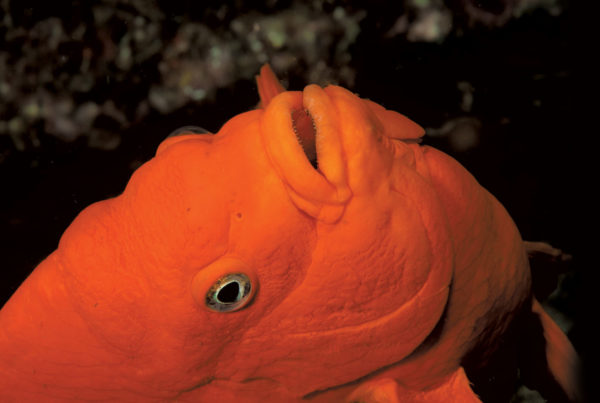
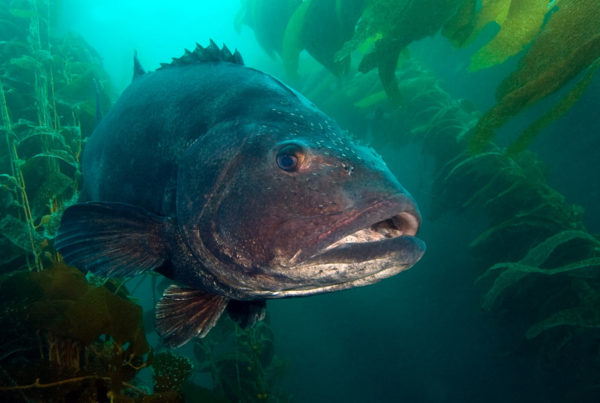
Perhaps the best reason to visit this reef, however, is the fish life. This is possibly the fishiest reef off Laguna Beach. Small giant black sea bass have been seen here. In the sand you will spot guitarfish and huge bat rays. Across the reef it gets even better. Large sargo cruise the rocks. Perch of a number of varieties dart here and there. Calico and sand bass are abundant but most are small, so spearfishers should not get their hopes up. Also adding color are numerous small sheephead and a huge amount of garibaldi.
Conditions at Deadman’s are generally good, better than nearby close-to-shore sites. Visibility averages 15 to 20 feet. A gentle current sometimes sweeps the location with clean, clear water. Watch out for the surge in the shallow portions of the reef.
Another reason to dive this site is to avoid the crowds. Laguna Beach is a very popular beach diving localethe most popular in the L.A. Metropolitan area, if not all of Southern California. But most of the activity here concentrates around three dive sites: Picnic Beach (Heisler Park), Diver’s Cove, and Shaw’s Cove. While these are great dives, the heavy weekend diver traffic at times can be a bit daunting. Another popular dive is Crescent Bay. But most divers here stick to the nearshore point to the southeast and Seal Rock on the northwest. Sea lion encounters are great, but the best diving is further out at Deadman’s Reef.
Surf entry at Crescent Bay is frankly not as easy as the other nearby spots at Laguna Beach (Shaw’s, Fisherman’s and Diver’s Coves). The beach is more open to the surf and the shore break can be a bit more intense. Beach diving experience is a must and time your entries and exits. Remember know your limitations! Surf can come up unexpectedly here.
From the beach it is about a 200-yard swim out to Seal Rock and another couple hundred yards to Deadman’s Reef. To shorten the swim a bit, head straight out from the beach 210 degrees, line up the two seal rocks with the big gray-roofed house on the bluff and drop down. Sounds simple, right? It is, however, surprising how many miss a structure like this that is quite large. When you drop down, if you find yourself in 45 feet of water or less, head out angling to the right of the ripples in the sand. If you hit 47-48 feet with no reef in sight, turn right and you should run into the reef. If you run into a small strip of rocks out on the sand, follow this to the reef. This mini-reef was put here years ago by some diver and is affectionately known as “deadhenge” (after “Stonehenge) because of it mystery appearance.
For coming back into the beach, start back with about 1,200 p.s.i. left in your tank so that you can lessen the arduous swim back by exploring the underwater environs across the sand flats.
While reaching the staging area for diving off Crescent Bay is easy to reach, it is parking that can be troublesome but not if you know where to go. Turn off Pacific Coast Highway onto the north entrance of Cliff Drive. The steps to the beach will be straight ahead. There is another access point down the street to the left but this is further from the beach entry for Deadman’s (but it does have the added bonus of restrooms and a shower). Parking is along the street but is extremely limited. If you find yourself shut out of parking here you can head to the “upper” parking area along Crescent Bay Drive. There is a small set of stairs between the small spur road off Crescent Bay Drive that leads to the shore access at Circle Way.
Crescent Bay is a beautiful beach and worthy of a full day of just lounging. And although Deadman’s Reef is a long swim, it is definitely worth a full dive.
Dive Spot At A Glance
Location: North end of the community of Laguna Beach, Orange County.
Access and Entry: A few steep steps to sand beach surf entry.
Depths: 15 to 60 feet. Typical diving depth is 45 feet.
Visibility: Averages 15 feet but variable across the reef.
Skill: Intermediate or better with good surf entry/exit experience, navigational skill and stamina for a long swim.
Photography: Good for nudibranchs, octopus and reef fish. Only fair for wide-angle shots because of limited visibility. Use caution in taking your camera through the surf.
Hunting: Only finfish and lobster (in season) can be taken within Fish & Game regulations. No mollusks can be taken.
Hazards: Surf can come up.
Facilities: Limited parking, restrooms with shower on southeast end of beach. For diving conditions (at nearby Shaw’s Cove) visit www.lagunaseasports.com online.
Dale Sheckler is editor and publisher of California Diving News and co-author of the book Southern California's Best Beach Dives.
© Copyright 2007, all rights reserve, by Saint Brendan Corporation, P.O. Box 11231, Torrance CA 90510, mail@cadivingnews.com. No part of this may be reproduced, stored in a retrieval system/website, or transmitted in any form by any means without prior written permission of the publisher.
IMPORTANT NOTICE:
The contents of this publication/website are opinions of the individual writers. The publishers of California Diving News and its contributors assume no responsibility for any mishap claimed to be a result of use of this material. Diving is an adventure sport and with it comes inherent risks. Improper use of diving equipment or improper diving techniques may result in serious injury or, in extreme circumstances, death. Readers are admonished to use their own best judgement in each individual situation. |
|
|