Printer-Friendly | Back

This is literally a mountain of a dive site. With a base as much as 130 feet below the surface and a rock pinnacle rising 66 feet above the water line, this rocky edifice has an overall rise of nearly 200 feet from top to bottom. Underwater are sheer wall faces, plateaus and ridges, and jumbled boulders. Most divers agree this is the most spectacular dive site on the front side of Catalina.

There are several sections of this popular dive site to explore. Beginners will like “The Aquarium.” This is a shallow shelf on the southwestern side of the rock that is protected from the prevailing northwest winds. When waters are calm, this is a good place for beginners and snorkelers. Another section is the ridge that extends off the southeastern side. It is marked by a number of wash rocks that, if not avoided, can spell trouble for boaters. Such was the fate of the Diosa Del Mar in 1990. The 1898, 67-foot long sailing schooner met its death on these rocks. Wreckage can be found on the eastern side of this ridge from shallow waters down the steep slope.

The section of the reef favored by most intermediate to advanced divers is the northwest side of the rock. Here the rock drops off quickly to a small plateau at 20 to 30 feet and then continues onward nearly vertical to about 80 to 90 feet and onward over jumbled boulders to 125 feet. The best part of the rock face is from 30 to 80 feet with its numerous deep crevices and sheer rock faces. A predominate animal on these rock faces is the beautiful bright yellow Zoanthid anemones. While these anemones are relatively tiny, about a quarter-inch at the base, they collect in huge colonies that appear as if somebody hung a shag yellow carpet on a wall. They make an excellent backdrop for fish photography, both macro and wide-angle.

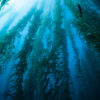
Speaking of fish, this is one of Catalina’s best. “Blizzards” of fish is the best way to describe the amount of fish life you will see here. Huge schools of blacksmith move in and out of the kelp. Occasionally schools of mackerel seem to blot out the sun. In these schools look for individuals that bear the wounds of combat. That indicates the presence of large predatory fish such as yellowtail and white sea bass. Keep your eyes open for these fish as they are known to frequent here.

For an unusual fish sight for the advanced diver, head for the sandy bottom base around the rock pinnacle at 120 to 130 feet. This is the best place in Southern California for an opportunity of seeing an angel shark. Approach low and slow and they will let you get quite close.

Reef fish are abundant as well. Colorful blue-banded gobies are all over the rocks. Thousands of señoritas flit about as does their cousin, the rock wrasse. Look for the colorful adult that varies in color from orange to green. They are easily identified by the vertical bar behind their pectoral fin. Another member of the wrasse family more familiar to divers is the sheephead. While present here, large male are unfortunately uncommon and wary likely due to heavy hunting pressure. Other reef fish include garibaldi, scorpionfish, horn sharks, moray eels, and, in the late summer and early fall, the illusive scythe butterflyfish.

Invertebrates include numerous giant keyhole limpets, nudibranchs, rock scallops, an occasional lobster, and beautiful stands of red and golden gorgonian. These make for excellent wide-angle photo opportunities with the backdrop of kelp and clear water.

And clear water is what this dive site is famous for! Catalina Island is good enough but Ship Rock is over a mile out from the island in clear current swept waters. Even on a bad day you can expect visibility at 40 feet. Late fall and early winters can bring water clarity upward of 100 feet.

As stated, this dive site is swept with currents. Proper current diving techniques are a must. And the currents here tend to swirl so pay attention to where you are relative to the boat and always use a trailing current line.

Mountains are always fun to explore, especially if they are underwater! Ship Rock is one of those dives you will remember for many years.

Dive Spot At A Glance
Location: A little over a mile out from the Isthmus on the front side of Catalina. Marked on most charts.
Access: Boat only. Experienced skippers only as anchorage can be difficult.
Visibility: Excellent with 40 to 60 average, sometimes 100+.
Skill: Depends on section (see text).
Photography: Excellent with many macro subjects and great kelp shots with many fish and clear water.
Hunting: Occasional lobster and rock scallop. Calico bass, yellowtail and white seabass for the skilled spearfisher.
Hazards: Currents frequent and sometimes strong.
Suggested Charter Boats Serving This Area:
Mr. C - (310) 521-9737
Scuba Cat - (800) 353-0330
Island Time - (866) 488-3483
Magician - (661) 268-0590
Great Escape – (866) 348-3262
or see the California Scuba Calendar section of this issue for trips to Catalina Island


Dale Sheckler is editor and publisher of California Diving News and co-author of the book Southern California's Best Beach Dives.

© Copyright 2007, all rights reserve, by Saint Brendan Corporation, P.O. Box 11231, Torrance CA 90510, mail@cadivingnews.com. No part of this may be reproduced, stored in a retrieval system/website, or transmitted in any form by any means without prior written permission of the publisher.

IMPORTANT NOTICE:
The contents of this publication/website are opinions of the individual writers. The publishers of California Diving News and its contributors assume no responsibility for any mishap claimed to be a result of use of this material. Diving is an adventure sport and with it comes inherent risks. Improper use of diving equipment or improper diving techniques may result in serious injury or, in extreme circumstances, death. Readers are admonished to use their own best judgement in each individual situation.

Dive Spots
Underwater
Reviews
News
BackIssues
Subscribe
Contact
California Diving News is Copyright © 2007 Saint Brendan Corp. All Rights Reserved.

Site Map | About Us | Contact Us | Who is Saint Brendan?