Printer-Friendly | Back
Few sites offer one-stop shoppingsomething for nearly every diverbut Eagle Reef, on the front side of Catalina, most certainly does. Sightseers, hunters and photographers will all enjoy diving here and, on those days when the current is slight or nonexistent, it is also suitable for divers of all skill levels.
Eagle Reef is approximately one-quarter mile offshore and a mile west of Ship Rock. It consists of three kelp-shrouded rocky pinnacles, the shallowest of which comes within three feet of the surface. The tops of the other two rise to within 15 and 30 feet. The maximum depth off all three is 100 to 120 feet.
The reef is easy to find. Because it’s shallow, it’s a hazard to navigation and the six-fathom spot sports a big red buoy. Most dive boats anchor on the shallowest pinnacle.
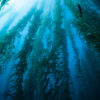
Because it’s offshore and rocky, Eagle Reef generally offers excellent visibility. The kelp-covered site is an oasis in the sea, sheltering sundry marine life.
Divemasters usually recommend following the anchor line to the pinnacle. There, you can choose your depth, staying shallow or dropping deep. Take a few minutes to look around at the beginning of your dive. Eagle is a peaceful place with fish, including blacksmith, señoritas and opaleye, schooling in the lush kelp forest. During nesting season, garibaldi build nests here. After the eggs hatch, this is a good place to see the juveniles. Bright orange with neon blue markings, they are eye-catching.
When you’ve enjoyed the wide-angle scenery, notice that brown and golden gorgonian seafans are abundant. On their branches, look for the little snails known as Simnia vidleri, which exactly match the color of the fan on which they live. You will also see bluebanded gobies; tiny, colorful tube worms; hermit crabs; and various snails, often well camouflaged because of the growth on their shells. Inthe crevices you might find horn sharks and octopus.
By now you’ve noticed that antennae bristle seemingly everywhere. Lobsters, including those of legal size, are plentiful. That’s probably because Eagle is honeycombed with deep crevices into which these creatures quickly learn to retreat. Only the most skillful hunters will catch the wily crustaceans here.
Besides making the reef easy to find, using the anchor line to get to and from Eagle Reef is also a good idea because there can be a lot of boat traffic here. The site is near Isthmus Cove, Fourth of July Cove and Cherry Cove. Although boaters should recognize the red and white divers down flag and keep well clear, many have no idea what it means and may even sail or motor close to find out what’s going on.
One site, numerous things to see and do. Check out Eagle Reef on your next trip to Santa Catalina Island.
Bonnie J. Cardone was certified in 1973 and received the California Scuba Service Award in 1999. She spends a great deal of time sitting at her computer, composing mystery novels she hopes someone will buy someday. If you’re a literary agent, give her a jingle.
© Copyright 2006, all rights reserve, by Saint Brendan Corporation, P.O. Box 11231, Torrance CA 90510, mail@cadivingnews.com. No part of this may be reproduced, stored in a retrieval system/website, or transmitted in any form by any means without prior written permission of the publisher.
IMPORTANT NOTICE:
The contents of this publication/website are opinions of the individual writers. The publishers of California Diving News and its contributors assume no responsibility for any mishap claimed to be a result of use of this material. Diving is an adventure sport and with it comes inherent risks. Improper use of diving equipment or improper diving techniques may result in serious injury or, in extreme circumstances, death. Readers are admonished to use their own best judgement in each individual situation. |
|
|